










NOTES COMPLETED FROM MY DIARY
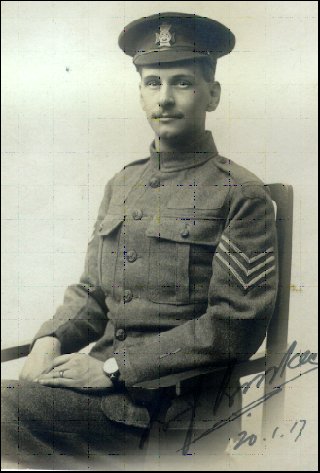
A
True and Personal Record of Experiences as a
Signaller
in the Army at Home and Abroad during
THE
EUROPEAN WAR
(1914)
written
by
Sergeant
Bernard Joseph Brookes
1/16
Battalion County of London Regiment
(Queens
Westminster Rifles)
*******
INTRODUCTION
28.6.1914
On Sunday 28th June in the year 1914 I was at Newport in Monmouthshire, having
completed one week of a cycling tour through Gloucestershire, the Black
Mountains in South Wales and the beautiful Wye Valley.
Whilst walking down the High Street, I noticed a crowd outside the local
Newspaper Office and I saw the announcement of the assassination of the Archduke
Francis Ferdinand of Austria and his wife, the Duchess of Hohenburg, at Serajevo.
I continued on my way and having forgotten almost as soon as I had read this
announcement, like so many others, I never imagined how far reaching the effect
of this assassination would be and how our enemies would use it as an excuse to
start the sanguinary War in which nearly all civilised Europe is now engaged.
But as this is a personal history, let me look at it in a personal light. It
meant to me that before long I was to give up my peaceful (if somewhat dull)
life in England to be placed in a short time on the Battlefield, Where I, like
so many of my fellow-countrymen, would have to fight the enemy who is without
scruples - to live for months, knowing that any minute might be the last - with
bloodshed, sickness, hunger, thirst and all the hardships which are necessarily
the lot of a Soldier in such a War as is now raging on the Continent.
*****
CHAPTER 1
ENGLAND
29.6.1914
I continued on my Cycle Tour leaving Newport the next day, Monday the 29th June 1914, by boat for Ilfracombe , and then cycled on touching Lynton, Lynmouth, Porlock, (where is the hill which is considered the worst in England) Bridgewater, Cheddar, Wells, Glastonbury (with its fine ruins), Stratton-on-Fosse, Frome, Salisbury and arrived back in London on Saturday the 4th July.
28.7.1914
Events moved rapidly and the War cloud looked as though it could not be dispersed and the climax was reached when on Tuesday 28th July, between Austria and Serbia a state of war was declared. London was all excitement and before the end of the month the Bank Rate had leaped from 3% to 8%, and on the 1st August it stood at 10%.
3.8.1914
On Monday 3rd August (Bank Holiday) I went to the City in case War was declared by England and anything of importance should have to be done. Although the Firm I am with is Belgian, the Representative Principal and many in the business were Germs. Some of them had already left for Germany to fight against us, but there were still several at the Office who had not got the pluck to return and fight for their Country.
As I write I am pleased to say that the Office is now clear of anything Germy, and it is resolved that none of the Germs will ever set foot in the Office again if it is possible to avoid it.
4.8.1914
An ultimatum which England presented to Germany expired at 11.00 pm on Tuesday 4th August 1914 and from that time War was the order of the day.
5.8.1914
The next day, upon representations being made to an English Principal in the Firm, a promise was made that full salary would be paid and one’s position in the Firm assured at the conclusion of hostilities for those who joined the colours.
6.8.1914
(I tried to join the West Kent Yeomanry but they were full up).
7.8.1914
I immediately took steps to join a regiment and on Friday 7th August 1914, with Frank Croxford and George Steptoe (two colleagues from the Office) I went to the Headquarters of the 16th Battalion of the County of London Regiment, the Queens Westminster Rifles and after waiting outside 58, Buckingham Gate for two or three hours we struggled and pushed our way inside as soon as the door was opened - we were all so eager to join the Army. Strange to say, that men I have met since who have returned from the Front are even more eager to get out of it now, but although one had to wait a long time to get into the Army at the beginning of the War, one has to wait a sight longer to get out once in the Army.
After much swearing outside the building, we were ‘sworn in’ and then waited in turn to see the doctor. I passed the Doctor as ‘Fit’ and was posted to ‘E’ company. We then paid our entrance fee (rather a good idea - pay to serve one’s country) and the receipt for this money permitted free travelling on Motor Omnibuses and other conveyances, although in civilian clothes. Unfortunately this practice was not continued long enough to make up the entrance fee, but I honestly did my best.
8.8.1914
On Saturday 8th August I did my first drill which consisted chiefly of ‘marking time’, ‘right turning’ and ‘forming fours’ in the rain, which made me wish (so soon) that I had not been quite so keen in ‘joining up’ and had left it until after the weekend. On Sunday also we turned out for drill although we were still in civilian clothes, the necessary supply of khaki not being forthcoming.
11.8.1914
On Tuesday 11th August, Lieutenant-Colonel R. Schoolbred addressed the Battalion and asked the men to volunteer for Foreign Service. With large ideas of spending the winter in Egypt and on the whole having a rather good holiday (but not with the slightest thought of fighting or danger) we proudly agreed to serve in Foreign lands.
16.8.1914
I had been sleeping at home all this time and had no uniform, but on Sunday 16th August for the first time I slept in Westminster Schools. Of course this was my first experience of sleeping on boards, but it is not so bad on the floor once one gets used to it.
22.8.1914
My pride reached its height when on Saturday 22nd August I got onto my uniform. I did not know the correct way to adjust puttees (for there is a knack) but I got them fixed one way or an other. I also wore my bayonet, (which afterwards I learnt is only allowed to sergeants when off parade) and with my head high in the air went to Victoria and took the train to Epsom to meet the Cycling Club which had gone that way for their weekly ride. I slept at home that night.
25.8.1914
Tuesday 25th August saw us on our first Route March which was past Buckingham Palace and through the Park, and I am sure we were all very proud when the Guards outside the Palace ‘Presented Arms’ to us. We were ‘some’ soldiers.
26.8.1914
On Wednesday 26th August we were informed that the next day was to see us on our way to a training camp and this evening we had an excellent concert (very similar to those we have since had at the Front). It is very sad to look back and think that one or two singers of note who were so gay have now paid the price and given their lives for their Country.
27.8.1914
On Thursday 27th August there was a Requiem Mass at Westminster Cathedral for the Pope, who had died on 20th August, and after various inspections I managed to drop in at the Cathedral.
After dinner we paraded in the playground and with rifles at the ‘trail’ swung out of the gate to the echo of hearty cheering. Our hearts were full and we felt proud and happy.
The rain came on as we were marching down Victoria Street and instead of going through the City we dropped under the earth and took the tube to Euston. We had to parade outside the station and of course I forgot my place and number, for which I was hauled over the coals by Captain Shattock, but in the words of the song “What did I care?” for I had my rifle and khaki and a fairly good opinion of myself as a soldier.
We took the train to Boxmoor and some of the men had their people at the station and we got a good send off.
When we arrived at Boxmoor it was very hot. We paraded outside the station (I remembered my place this time) and had a three and a half mile march before us to Leverstock Green. By the time we had mastered the first hill (for there were several) I had lost all my pride and would willingly have given my rifle to anyone who might have liked it (and many others would have done the same), but no doubt we would have wanted them back later. What we realised was the difference between our Route March for a short distance on level ground in London and an uphill march feeling hungry and thirsty on a hot day.
We got to our quarters at about 6.00 pm and ‘E’ company were at Well Farm. We had some tea (without milk) and were placed on real Army diet for the first time. Before, we had been looked after by a caterer and on the whole we had good grub, although once some tinned fruit had upset half the company and two men had to go to Hospital. Some ‘old soldiers’ however put us up to the tricks of the trade and we all had pains (not too bad mind you), but just enough to keep us off Parade on a hot day.
After looking round the barn in the farm one of the fellows asked me if I would care for a walk round and I readily consented. We returned at 9.30 pm to find that various Sergeants and Corporals had been looking for us and that we should not have left our quarters without permission. Being new to Army discipline no fuss was made about the matter, but I was detailed for ‘Mess Orderly’ for the next day. (Resolution:- I must not forget that I am training for war and not on a holiday).
28.8.1914
I had better explain the important duties of the ‘Mess Orderly’ which I had the honour to perform. It meant rising half an hour before the others at 5.00 am (some ‘shiver’) and to cut up the bacon for the cook and after meals wash up the cooking utensils. I found that what with getting up so early, working as orderly and parades during the day, by the time it was evening I was fairly tired. I laid my weary body on it’s straw bed and my coconut on my kit bag and dropped off into a sound sleep. At 11.15 pm we had a ‘Night Alarm’ and had to turn out in the cold to see how long it would take us to get clear of our quarters in the event of such a necessity arising. As far as I can remember, I created the record (although unfortunately at the wrong end), for our barn was last out and I was the last out of the barn.
29.8.1914
The next night was a little less exciting for we were not turned out of our ‘beds’ (straw thrown on the floor), but were not allowed in them until we had ‘Night Operations’ from 9.00 pm until 11.00 pm. For the uninitiated let me explain what ‘Night Operations’ are. According to the Army it is practising to March in the dark, silently and in perfect order. Instead of having commands shouted out, one must, by constant watching, see what has to be done by noticing the movements of the men on either side and do likewise as smartly as if on the Barrack Square. As a matter of fact it actually consists of men jumping on one another’s heels, much swearing and finishing up by getting hopelessly lost. However in a short time one improves and ‘Night Ops.’ are really of the utmost importance as so much work is done at night at the Front and of course noiselessness is essential.
30.8.1914
The next day being Sunday, the Catholics paraded in undress uniform and marched to Church at Boxmoor and as it was a nice day and we had no equipment, we quite enjoyed the journey. At Church, Sergeant Major W. J. Price (who has lately been awarded the D.C.M.) came up with his men (R.F.A.) and I had a chat with him, again feeling proud (I soon lost my pride however) -a Rifleman on familiar terms with a Sergeant Major. During the afternoon I called on Frank Carroll in the Civil Service Rifles at Bedmond (which by the way was out of bounds) and we had tea in a cottage.
31.8.1914
On Monday 31st August I certainly had a stroke of luck and it amounted to this, that Colour Sergeant Turnball (since awarded the D.C.M.) told me I had been appointed a signaller for ‘E’ Company with Harrow and Rolfe. Why I was picked out for this duty, I really cannot say, but I believe that the Colour Sergeant must have had some bad reports about me, (for I had done any amount of things that I should not) and I was seen by him yesterday at Bedmond and have come to the conclusion that as a soldier, I was likely to be a ‘wash out’. Well I must say that I did not take kindly to the work of an infantryman in the company. There is plenty of dirty work to do, guards fatigues etc. and it is very monotonous, and looking back now, I feel sure that I would have disliked it intensely in France (for as you will see I was with the Company for a period at the Front) and feel sure that I could never have ‘stuck it’, but I took a liking to signalling, found it very interesting and not at all monotonous. Being chosen as a Signaller is by no means the only piece of luck which I have had during the period I have been serving in this War, and who knows where I would be now if it were not for the fact that I was picked out for this duty? A Signaller does no digging, guards, fatigues or dirty work, although when the Battalion is resting he has cycling duty and other work to do connected with signalling. So much for Signalling.
Until now I had been doing Company work, ‘Belly flopping’ (i.e. extended order drill) guards, digging, fatigues etc. but now started to master the mysteries of Morse code and Semaphore. A very interesting branch of a Signaller’s work is map reading, and occasionally, with the aid of a map we had to find our way through certain lanes to a given point. It is by no means as simple as it sounds.
7.9.1914
We had a Field Day on 7th September and the next day the Brigade (13th County of London, The Kensingtons, 14th London Scottish, 15th Civil Service Rifles, 16th Ourselves) turned out for a Route March and the Queen’s Westminsters led the Brigade.
About this time the Village Post Office found that they could not cope with the extra work which the influx of troops had occasioned and it fell to the lot of Signallers to take over the work connected with telegrams, and tender messages to sweethearts and wives had to be left at the mercy of the Signal Service section. I sincerely hope that all messages arrived at their destination with the wording correct, but I have my doubts.
20.9.1914
On Sunday 20th September I had leave to go home and fetch my cycle, having been informed that it would be purchased from me for military purposes, and left in my care. I left King’s Langley early in the morning with Rifleman Ford (who I am sorry to say was killed on 9th August 1915 on the Menin Road whilst carrying bombs to a captured Germ trench, during the Battle of Hooge) and took the train to Euston, and from there ‘taxied’ to Victoria and spent the day at home. I went to St. Anselm’s, Tooting Beck to church in the morning and evening. (This was to be the last I would be at home before going to the Front, but I had no idea of this at the time.) I cycled through London to Euston with the search lights glaring from various points. London was then fairly dark and cycling by no means easy. On arriving back at King’s Langley I cycled to the farm with Captain Challis. This Officer did not come out with us to France in November 1914, but arrived in Belgium a few days before the Battle of Hooge, returning on the day of the battle wounded.
21.9.1914
The 2nd London Division went for a Route March on Monday 21st September and the Artillery was also in attendance, but there is very little pleasure in a Route March of this description. It is so slow and the length of the troops in fours being so great, the unfortunate Battalions at the rear get a good meal of dust.
22.9.1914
The next day I was offered by Army Officials the sum of £5 for my bicycle and I was quite willing to accept this amount. The details I will not go into, but considering the length of time I had had the cycle and the amount of travelling I had done on it, it was quite a reasonable figure (from my point of view). We did not get the money for some little time but we all felt very pleased with ourselves over the various sums which had been allowed for the cycles, and yarns began to leak out about certain gentlemen having bought bikes a week or two before for prices of around £3 and getting the officials to allow £6 or £7 for them. But somehow or other, when it came to ‘paying out’ things did not turn out as well as might have been expected and some of us were badly bitten. I had my amount knocked down to £3. 15/- but I could not grumble even then. It is a hard job to ‘do’ the Army.
25.9.1914
A nasty business was the inoculation which we had to undergo on Friday 25th September, but it gave us a couple of days in which to play cards and rest, so we could not grumble even at that.
29.9.1914
Our great day was on Monday 29th September when the Division was inspected by Lord Kitchener. The details may be of interest.
Instructions were received during the night, and we had an early breakfast, parading on the green at 7.00 am. We marched, accompanied by the Band, to a park near St. Albans, the name of which I cannot call to mind. We were by no means the first Battalion on scene and it was a blazing hot day. The Division was drawn up on the slope of a hill, and as we marched to our position we could see a dense mass of men with bayonets brightly shining, and rifle barrels reflecting in the rays of the sun. We took up our position, and at the appointed time, Lord Kitchener put in his appearance. After inspecting the Infantry, the Artillery ‘marched past’ and one wondered how the Germs could possibly think that they could win the War when there were so many men and guns. It took a long time for the guns to pass and we were at ‘Attention’ all the time. No wonder such thoughts were in my mind.
1.10.1914
The next item of interest was the three days firing at Hemel Hempstead, commencing on Thursday 1st October. After I had fired my first shot, I thought the world had come to an end. The ‘kick’ of the rifle gave me an awful hit on the jaw and also bruised my shoulder badly. Of course the moral is to hold one’s rifle tightly. I got a good ‘tip’ and that was to put a sack under the coat by the shoulder, and so saved further trouble in this direction. I did rather well in my firing tests and when one gets used to a rifle it is very fascinating.
5.10.1914
We were inoculated again on Monday 5th October and had another two days rest, but at the end of these two days, who will ever forget what took place? Let me explain.
7.10.1914
At 12.35 am on Wednesday 7th October, orders were received to prepare to embark and we hastened out of our ‘beds’ and packed everything up. It was pitch dark and some of the men who had been inoculated some twelve hours before were feeling the effects rather badly, but even these turned out, as they were just as anxious as the others to go abroad as things were getting rather tame at home. Ammunition was served out, and every man took as much as possible, filling pockets and any available space, as we had heard that ammunition was scarce in France. We were all heavily laden, full packs and equipment. The Orderly Room packed up, and the transport was all ready under war conditions. The Canteens gave away their stock of Beer and Minerals, and other articles were disposed of wholesale. It is said that a certain Field Officer left a telegram at the Post Office to be dispatched first thing in the morning to his Wife, informing her of his departure.
We paraded on the Green, and a large number of the villagers turned out to wish us ‘Good-by’. We left about two hours after receiving our Orders, and proceeded to march to King’s Langley, a distance of about four miles. All was excitement. An empty train was in a siding a mile or two form the station, and it was decided that this was for us.
Arriving at King’s Langley station, we were full of expectation. After ten minutes wait the order was given to the Signallers (who always lead the Battalion) “Right wheel”, “Right wheel”, which amounts to “about turn”. We looked at one another and wondered what was happening, but thought that we were going to a siding. Our hopes, however, were dashed to the ground, for it was a false alarm! Let me pass over the language - it was too terrible.
A stranger passing down the road the next morning must surely have thought that a terrific battle had taken place there lately, judging by the amount of ammunition he would have found strewn by the wayside. We heard later that the whole Brigade had been out. All were late as regards the train they were supposed to have caught, but the Westminsters were the ‘limit’ being two hours over the time. ‘Twas sad’.
10.10.1914
On Saturday 10th October the Signallers were moved into a Farm by themselves and taken away from the Company. It was very comfortable, and the quarters were better than those in which we had been.
The country around was very pretty and we had many a day’s outing, (pardon Battalion and Brigade Field days) when we had to cook our own dinner. On the whole we enjoyed them immensely, especially the Signallers with their bicycles who somehow or other often managed to get lost, but they could usually be found in the local ‘pub’.
26.10.1914
A very enjoyable afternoon was spent by us on Monday 26th October when the Signallers went for a cycle ride through Flamstead and Radbourne. Some of us were so much behind schedule time that the Signalling Officer who waited on the road to check times, etc., caught a chill leading to an illness which ultimately prevented him from coming abroad with us. Well, we can hardly be blamed, for it was a very hot day as far as cycling was concerned, and we got so very dry.
This incident proved to be the completion of our ‘training’. As far as the Signalling section went, we knew very little of the Morse Code (which is used in France) but we were quite proficient in Semaphore (which is not used - except in emergencies).
27.10.1914
The next day, Tuesday 27th October, definite orders were received that we were to prepare to leave England. This time it was the real thing. Again all was excitement. Our transport was condemned, and we had to obtain new horses and carts; new rifles were served out; and Khaki overcoats borrowed from the Civil Service Rifles in place of our grey (for the C.S.R. were not coming with us, and they eventually took over the billets at Watford which had been prepared for us for the winter). No leave was granted to Officers or men before going to the Front, although it is said an effort was made in this direction.
30.10.1914
We were to have left on Friday 30th October, but, arrangements between the War Office and the Regiment not being completed, we waited expectantly for instructions to move.
31.10.1914
On Saturday 31st October we were inspected by the Brigadier. In the afternoon I was on Post Office duty when the Colonel handed in a telegram to say we were off to-morrow.
1.11.1914
We were all up early on Sunday 1st November for we had plenty to do. Of course the village turned out to wish us ‘Good-bye’. The Battalion went in two parts, the right-half battalion under the Colonel, and the left-half battalion under Major J. W. Cohen at 10.30 am. The Band struck up ‘Auld Lang Syne’ as the left-half battalion moved off. Only the Signallers were left, and we dismissed for a short time and entered the ‘Tuck-shop’, and at 11.00 am left Leverstock Green on our bicycles for Watford, arriving there about 11.30 am. The Battalion had a good reception when marching through the town.
The transport and men being entrained, we started at 12.40 pm leaving many sad hearts behind. We passed through Willesden, Basingstoke, Winchester, and arrived at Southampton about 4.30 pm (‘some’ train). Tea was served out, and we then boarded the S.S._’MAIDAN’. (Burnt and sunk later in Manila Harbour)
At Southampton there was nobody to see the men off - in fact the town knew nothing about us being near for we came straight from the train onto the quay.
There was over us all a sense of loneliness, for as we looked over the side of the vessel, there were only two or three seamen on the quay. However I managed to get one of them to send off a card giving the name of the ship on which we sailed. Everybody on board was strangely quiet - all the excitement had died down, and there was a tremendous calm. At 7.30 pm, just as the steamer commenced to slip away from the quay, somebody struck up ‘Auld Lang Syne’ and to this tune the Queen’s Westminster Rifles left England, to help in the protection of our shores. Unfortunately so many of them left it for the last time - never to return.